Types and operating principles
Gas lasers
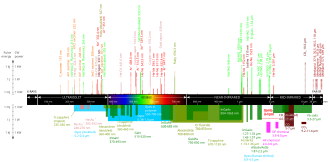
Following the invention of the HeNe gas laser, many other gas discharges have been found to amplify light coherently. Gas lasers using many different gases have been built and used for many purposes. The helium–neon laser (HeNe) is able to operate at a number of different wavelengths, however the vast majority are engineered to lase at 633 nm; these relatively low cost but highly coherent lasers are extremely common in optical research and educational laboratories. Commercial carbon dioxide (CO2) lasers can emit many hundreds of watts in a single spatial mode which can be concentrated into a tiny spot. This emission is in the thermal infrared at 10.6 µm; such lasers are regularly used in industry for cutting and welding. The efficiency of a CO2 laser is unusually high: over 30%. Argon-ion lasers can operate at a number of lasing transitions between 351 and 528.7 nm. Depending on the optical design one or more of these transitions can be lasing simultaneously; the most commonly used lines are 458 nm, 488 nm and 514.5 nm. A nitrogen transverse electrical discharge in gas at atmospheric pressure (TEA) laser is an inexpensive gas laser, often home-built by hobbyists, which produces rather incoherent UV light at 337.1 nm. Metal ion lasers are gas lasers that generate deep ultraviolet wavelengths. Helium-silver (HeAg) 224 nm and neon-copper (NeCu) 248 nm are two examples. Like all low-pressure gas lasers, the gain media of these lasers have quite narrow oscillation linewidths, less than 3 GHz (0.5 picometers), making them candidates for use in fluorescence suppressed Raman spectroscopy.
Lasing without maintaining the medium excited into a population inversion was demonstrated in 1992 in sodium gas and again in 1995 in rubidium gas by various international teams. This was accomplished by using an external maser to induce "optical transparency" in the medium by introducing and destructively interfering the ground electron transitions between two paths, so that the likelihood for the ground electrons to absorb any energy has been cancelled.
Chemical lasers
Chemical lasers are powered by a chemical reaction permitting a large amount of energy to be released quickly. Such very high power lasers are especially of interest to the military, however continuous wave chemical lasers at very high power levels, fed by streams of gasses, have been developed and have some industrial applications. As examples, in the hydrogen fluoride laser (2700–2900 nm) and the deuterium fluoride laser (3800 nm) the reaction is the combination of hydrogen or deuterium gas with combustion products of ethylene in nitrogen trifluoride.
Excimer lasers
Excimer lasers are a special sort of gas laser powered by an electric discharge in which the lasing medium is an excimer, or more precisely an exciplex in existing designs. These are molecules which can only exist with one atom in an excited electronic state. Once the molecule transfers its excitation energy to a photon, its atoms are no longer bound to each other and the molecule disintegrates. This drastically reduces the population of the lower energy state thus greatly facilitating a population inversion. Excimers currently used are all noble gas compounds; noble gasses are chemically inert and can only form compounds while in an excited state. Excimer lasers typically operate at ultraviolet wavelengths with major applications including semiconductor photolithography and LASIK eye surgery. Commonly used excimer molecules include ArF (emission at 193 nm), KrCl (222 nm), KrF (248 nm), XeCl (308 nm), and XeF (351 nm). The molecular fluorine laser, emitting at 157 nm in the vacuum ultraviolet is sometimes referred to as an excimer laser, however this appears to be a misnomer inasmuch as F2 is a stable compound.
Solid-state lasers
Solid-state lasers use a crystalline or glass rod which is "doped" with ions that provide the required energy states. For example, the first working laser was a ruby laser, made from ruby (chromium-doped corundum). The population inversion is actually maintained in the dopant. These materials are pumped optically using a shorter wavelength than the lasing wavelength, often from a flashtube or from another laser. The usage of the term "solid-state" in laser physics is narrower than in typical use. Semiconductor lasers (laser diodes) are typically not referred to as solid-state lasers.
Neodymium is a common dopant in various solid-state laser crystals, including yttrium orthovanadate (Nd:YVO4), yttrium lithium fluoride (Nd:YLF) and yttrium aluminium garnet (Nd:YAG). All these lasers can produce high powers in the infrared spectrum at 1064 nm. They are used for cutting, welding and marking of metals and other materials, and also in spectroscopy and for pumping dye lasers. These lasers are also commonly frequency doubled, tripled or quadrupled to produce 532 nm (green, visible), 355 nm and 266 nm (UV) beams, respectively. Frequency-doubled diode-pumped solid-state (DPSS) lasers are used to make bright green laser pointers.
Ytterbium, holmium, thulium, and erbium are other common "dopants" in solid-state lasers. Ytterbium is used in crystals such as Yb:YAG, Yb:KGW, Yb:KYW, Yb:SYS, Yb:BOYS, Yb:CaF2, typically operating around 1020–1050 nm. They are potentially very efficient and high powered due to a small quantum defect. Extremely high powers in ultrashort pulses can be achieved with Yb:YAG. Holmium-doped YAG crystals emit at 2097 nm and form an efficient laser operating at infrared wavelengths strongly absorbed by water-bearing tissues. The Ho-YAG is usually operated in a pulsed mode, and passed through optical fiber surgical devices to resurface joints, remove rot from teeth, vaporize cancers, and pulverize kidney and gall stones.
Titanium-doped sapphire (Ti:sapphire) produces a highly tunable infrared laser, commonly used for spectroscopy. It is also notable for use as a mode-locked laser producing ultrashort pulses of extremely high peak power.
Thermal limitations in solid-state lasers arise from unconverted pump power that heats the medium. This heat, when coupled with a high thermo-optic coefficient (dn/dT) can cause thermal lensing and reduce the quantum efficiency. Diode-pumped thin disk lasers overcome these issues by having a gain medium that is much thinner than the diameter of the pump beam. This allows for a more uniform temperature in the material. Thin disk lasers have been shown to produce beams of up to one kilowatt.
Fiber lasers
Solid-state lasers or laser amplifiers where the light is guided due to the total internal reflection in a single mode optical fiber are instead called fiber lasers. Guiding of light allows extremely long gain regions providing good cooling conditions; fibers have high surface area to volume ratio which allows efficient cooling. In addition, the fiber's waveguiding properties tend to reduce thermal distortion of the beam. Erbium and ytterbium ions are common active species in such lasers.
Quite often, the fiber laser is designed as a double-clad fiber. This type of fiber consists of a fiber core, an inner cladding and an outer cladding. The index of the three concentric layers is chosen so that the fiber core acts as a single-mode fiber for the laser emission while the outer cladding acts as a highly multimode core for the pump laser. This lets the pump propagate a large amount of power into and through the active inner core region, while still having a high numerical aperture (NA) to have easy launching conditions.
Pump light can be used more efficiently by creating a fiber disk laser, or a stack of such lasers.
Fiber lasers have a fundamental limit in that the intensity of the light in the fiber cannot be so high that optical nonlinearities induced by the local electric field strength can become dominant and prevent laser operation and/or lead to the material destruction of the fiber. This effect is called photodarkening. In bulk laser materials, the cooling is not so efficient, and it is difficult to separate the effects of photodarkening from the thermal effects, but the experiments in fibers show that the photodarkening can be attributed to the formation of long-living color centers.citation needed
Photonic crystal lasers
Photonic crystal lasers are lasers based on nano-structures that provide the mode confinement and the density of optical states (DOS) structure required for the feedback to take place.clarification needed They are typical micrometer-sizeddubious and tunable on the bands of the photonic crystals.clarification needed
Semiconductor lasers
Semiconductor lasers are diodes which are electrically pumped. Recombination of electrons and holes created by the applied current introduces optical gain. Reflection from the ends of the crystal form an optical resonator, although the resonator can be external to the semiconductor in some designs.
Commercial laser diodes emit at wavelengths from 375 nm to 3500 nm. Low to medium power laser diodes are used in laser pointers, laser printers and CD/DVD players. Laser diodes are also frequently used to optically pump other lasers with high efficiency. The highest power industrial laser diodes, with power up to 20 kW, are used in industry for cutting and welding. External-cavity semiconductor lasers have a semiconductor active medium in a larger cavity. These devices can generate high power outputs with good beam quality, wavelength-tunable narrow-linewidth radiation, or ultrashort laser pulses.
In 2012, Nichia and OSRAM developed and manufactured commercial high-power green laser diodes (515/520 nm), which compete with traditional diode-pumped solid-state lasers.
Vertical cavity surface-emitting lasers (VCSELs) are semiconductor lasers whose emission direction is perpendicular to the surface of the wafer. VCSEL devices typically have a more circular output beam than conventional laser diodes. As of 2005, only 850 nm VCSELs are widely available, with 1300 nm VCSELs beginning to be commercialized, and 1550 nm devices an area of research. VECSELs are external-cavity VCSELs. Quantum cascade lasers are semiconductor lasers that have an active transition between energy sub-bands of an electron in a structure containing several quantum wells.
The development of a silicon laser is important in the field of optical computing. Silicon is the material of choice for integrated circuits, and so electronic and silicon photonic components (such as optical interconnects) could be fabricated on the same chip. Unfortunately, silicon is a difficult lasing material to deal with, since it has certain properties which block lasing. However, recently teams have produced silicon lasers through methods such as fabricating the lasing material from silicon and other semiconductor materials, such as indium(III) phosphide or gallium(III) arsenide, materials which allow coherent light to be produced from silicon. These are called hybrid silicon laser. Recent developments have also shown the use of monolithically integrated nanowire lasers directly on silicon for optical interconnects, paving the way for chip level applications. These heterostructure nanowire lasers capable of optical interconnects in silicon are also capable of emitting pairs of phase-locked picosecond pulses with a repetition frequency up to 200 GHz, allowing for on-chip optical signal processing. Another type is a Raman laser, which takes advantage of Raman scattering to produce a laser from materials such as silicon.
Dye lasers
Dye lasers use an organic dye as the gain medium. The wide gain spectrum of available dyes, or mixtures of dyes, allows these lasers to be highly tunable, or to produce very short-duration pulses (on the order of a few femtoseconds). Although these tunable lasers are mainly known in their liquid form, researchers have also demonstrated narrow-linewidth tunable emission in dispersive oscillator configurations incorporating solid-state dye gain media. In their most prevalent form these solid state dye lasers use dye-doped polymers as laser media.
Free-electron lasers
Free-electron lasers, or FELs, generate coherent, high power radiation that is widely tunable, currently ranging in wavelength from microwaves through terahertz radiation and infrared to the visible spectrum, to soft X-rays. They have the widest frequency range of any laser type. While FEL beams share the same optical traits as other lasers, such as coherent radiation, FEL operation is quite different. Unlike gas, liquid, or solid-state lasers, which rely on bound atomic or molecular states, FELs use a relativistic electron beam as the lasing medium, hence the term free-electron.
Exotic media
The pursuit of a high-quantum-energy laser using transitions between isomeric states of an atomic nucleus has been the subject of wide-ranging academic research since the early 1970s. Much of this is summarized in three review articles. This research has been international in scope, but mainly based in the former Soviet Union and the United States. While many scientists remain optimistic that a breakthrough is near, an operational gamma-ray laser is yet to be realized.
Some of the early studies were directed toward short pulses of neutrons exciting the upper isomer state in a solid so the gamma-ray transition could benefit from the line-narrowing of Mössbauer effect. In conjunction, several advantages were expected from two-stage pumping of a three-level system. It was conjectured that the nucleus of an atom, embedded in the near field of a laser-driven coherently-oscillating electron cloud would experience a larger dipole field than that of the driving laser. Furthermore, nonlinearity of the oscillating cloud would produce both spatial and temporal harmonics, so nuclear transitions of higher multipolarity could also be driven at multiples of the laser frequency.
In September 2007, the BBC News reported that there was speculation about the possibility of using positronium annihilation to drive a very powerful gamma ray laser. Dr. David Cassidy of the University of California, Riverside proposed that a single such laser could be used to ignite a nuclear fusion reaction, replacing the banks of hundreds of lasers currently employed in inertial confinement fusion experiments.
Space-based X-ray lasers pumped by a nuclear explosion have also been proposed as antimissile weapons. Such devices would be one-shot weapons.
Living cells have been used to produce laser light. The cells were genetically engineered to produce green fluorescent protein (GFP). The GFP is used as the laser's "gain medium", where light amplification takes place. The cells were then placed between two tiny mirrors, just 20 millionths of a meter across, which acted as the "laser cavity" in which light could bounce many times through the cell. Upon bathing the cell with blue light, it could be seen to emit directed and intense green laser light.


Comments
Post a Comment