Design
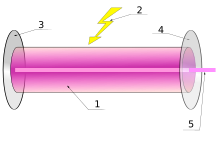
A laser consists of a gain medium, a mechanism to energize it, and something to provide optical feedback. The gain medium is a material with properties that allow it to amplify light by way of stimulated emission. Light of a specific wavelength that passes through the gain medium is amplified (increases in power).
For the gain medium to amplify light, it needs to be supplied with energy in a process called pumping. The energy is typically supplied as an electric current or as light at a different wavelength. Pump light may be provided by a flash lamp or by another laser.
The most common type of laser uses feedback from an optical cavity—a pair of mirrors on either end of the gain medium. Light bounces back and forth between the mirrors, passing through the gain medium and being amplified each time. Typically one of the two mirrors, the output coupler, is partially transparent. Some of the light escapes through this mirror. Depending on the design of the cavity (whether the mirrors are flat or curved), the light coming out of the laser may spread out or form a narrow beam. In analogy to electronic oscillators, this device is sometimes called a laser oscillator.
Most practical lasers contain additional elements that affect properties of the emitted light, such as the polarization, wavelength, and shape of the beam.


Comments
Post a Comment